
Irrigation Repair in Tucson — Fast Diagnosis, Honest Pricing, Same-Week Service
Tucson is hard on irrigation systems
Tucson irrigation systems take a beating. Summer heat degrades surface drip lines faster than in moderate climates — UV exposure and ground movement from thermal expansion crack fittings that were perfectly fine in spring. Monsoon season brings power surges that kill controllers and voltage spikes that burn out solenoid valves. And Tucson’s notoriously hard water — high in calcium and magnesium — clogs emitters slowly and silently until the plants downstream start showing stress.
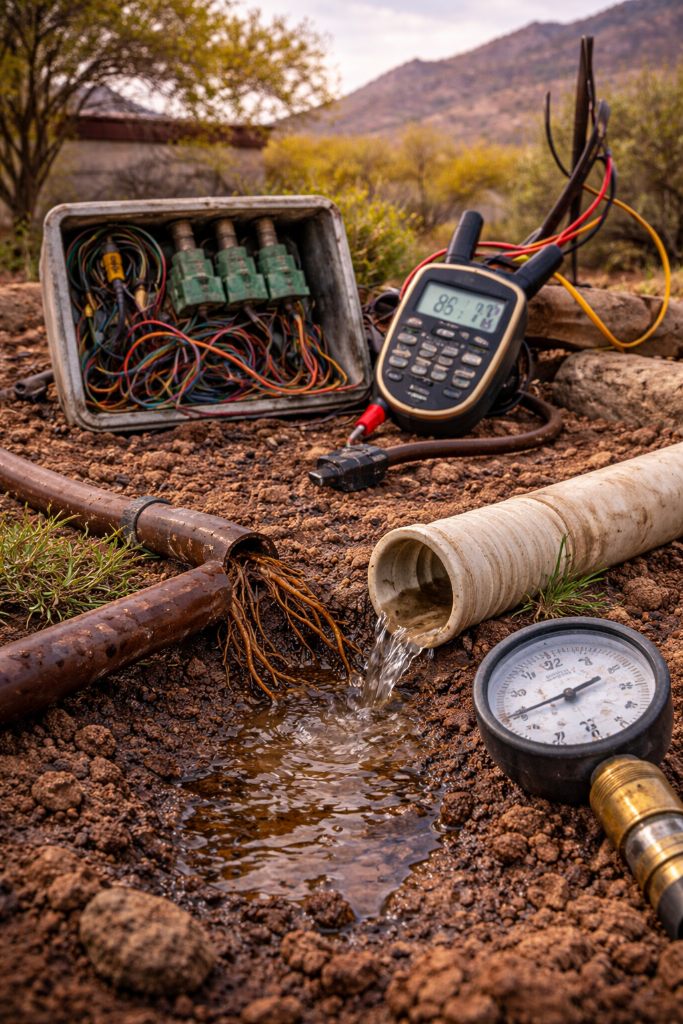
The most expensive irrigation failure is also the most invisible: a slow leak underground. An undetected leak can add hundreds of dollars to a water bill over a season while starving the plants it’s supposed to be serving. Our diagnostic process uses pressure testing and zone-by-zone flow monitoring to identify exactly where water is going — including where it shouldn’t be going.
- Monsoon power surges
- Hard water emitter clogging
- UV drip line degradation
- Root intrusion cracking
- Underground slow leaks
- Solenoid valve failure
We find it — we fix it
Leak Detection & Line Repair
We locate leaks using a combination of pressure testing, zone flow comparison, and visual soil inspection — looking for the tell-tale dark soil patches or unusually lush plant growth that signals an underground leak. Once located, we replace the damaged section with new line and fittings rated for Tucson’s soil and temperature conditions. We don’t patch; we replace — because a patched drip line in 115°F soil fails again within a season.
Common failure points we see in Tucson yards include poly line fittings under block walls, emitter heads pushed above grade by expanding soil, lateral line connections at the valve manifold, and compressed lines under driveways or pavement. Each location gets a permanent fix, not a temporary solution.
Controller & Valve Repair
Controller failures are one of the most common calls we receive after monsoon season. Lightning strikes and power surges travel through the transformer and fry the motherboard — leaving the system either non-functional or stuck in a continuous run cycle. Solenoid valve failures are equally common and often go undiagnosed as a controller problem.
We carry common replacement controllers and solenoids on every service call and can repair or replace most units in a single visit — then reprogram and verify every zone before we leave. If your system has been behaving erratically after the last storm, a valve or controller fault is the most likely cause.
Emitter Cleaning & Replacement
Tucson’s water is hard — high mineral content that slowly deposits calcium in drip emitters, reducing flow and creating coverage gaps that stress plants downstream. Annual emitter inspection and cleaning is one of the most cost-effective maintenance steps an irrigation system owner can take.
We flush the system, test flow rates at each emitter, and replace any unit that’s delivering less than its rated output — keeping every plant receiving what the design intended. Emitter replacement is fast, inexpensive, and immediately noticeable in plant recovery. If plants downstream of a particular emitter look stressed without any other explanation, a clogged emitter is almost always the cause.
Citrus & Specialty Plant Repair
Citrus trees showing yellowing leaves, fruit drop, or bark splitting are often misdiagnosed as diseased when the actual problem is irrigation failure — too shallow, too infrequent, or a cracked line that’s been delivering half the volume for months.
We specifically assess citrus tree irrigation depth and volume during our diagnostic visits, because getting it wrong is one of the most common — and most avoidable — causes of citrus decline in Tucson. A citrus tree receiving the correct irrigation schedule typically recovers from drought stress within one to two watering cycles.
Seasonal Maintenance Plans
The best way to avoid an emergency irrigation repair is a scheduled maintenance visit before problems develop. Our seasonal maintenance plan includes a spring system check — testing pressure, inspecting every emitter, adjusting controller schedules for summer demand — and a post-monsoon assessment covering storm damage and controller reprogramming for fall.
Plan members receive priority scheduling and a discount on any repairs identified during the visit. Two planned visits per year costs significantly less than one emergency repair call — and virtually eliminates mid-summer system failures during the hottest and most critical irrigation period.