
Stop Overwatering Your Tucson Landscape — And Lower Your Water Bill
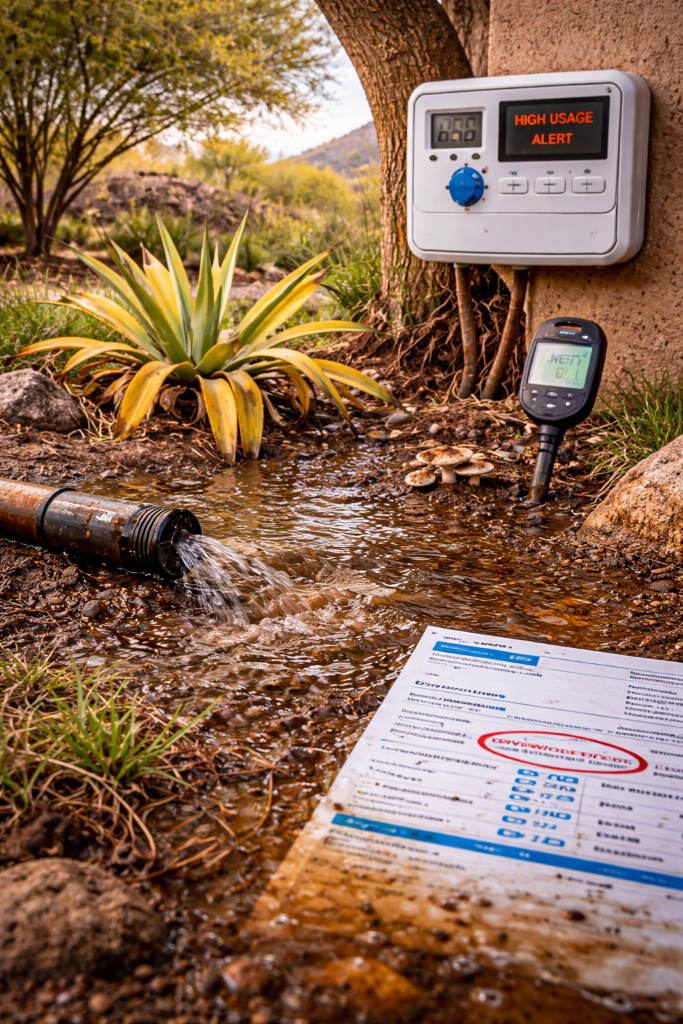
The average Tucson home overwaters by 30–50% during summer months — running schedules set in spring that don’t account for monsoon moisture, seasonal plant needs, or the difference between a Saguaro and a citrus tree. A water efficiency audit identifies exactly where your system is wasting water, and a smart controller upgrade makes sure it never happens again.
30 – 50%
Average Tucson overwatering in summer
20 – 40%
Typical water reduction after audit
70%
Less evaporation with drip vs. spray heads
1 season
Typical smart controller payback period
Why overwatering is Tucson’s most common — and most expensive — irrigation mistake
Tucson Water uses a tiered rate structure — the more water you use, the more expensive each additional gallon becomes. That means every gallon your irrigation system wastes isn’t just wasted water; it’s wasted money at an increasing rate. A system running 30% over actual plant needs during summer doesn’t just cost 30% more — it may be pushing you into a higher rate tier for the entire billing period.
The counterintuitive truth about desert irrigation is that overwatering is a far more common and damaging problem than underwatering. Saturated root zones drown native plants adapted to dry conditions, encourage shallow rooting that leaves trees vulnerable to monsoon wind, and create fungal conditions that harm the roots of even drought-tolerant species. The goal isn’t to water less — it’s to water smarter: the right amount, at the right depth, at the right frequency for each plant.
Smart watering means combining efficient hardware — drip delivery, smart controllers, soil moisture sensors — with the right scheduling knowledge. It means grouping plants with similar water needs on the same zone, adjusting run times seasonally rather than setting and forgetting, and auditing the system annually to catch drift before it shows up on your bill.
How we reduce your water use
Water Efficiency Audits
A water efficiency audit is a systematic review of everything your irrigation system is doing — and everything it’s doing wrong. We measure actual water output at each emitter against the design spec, compare total system runtime against evapotranspiration data for your specific plant types, check pressure at the source and at the end of each zone, and review controller schedules against current seasonal needs.
The result is a written report listing every inefficiency, ranked by water savings potential, with specific recommendations for adjustments or repairs. Most Tucson homeowners who complete an efficiency audit reduce water use by 20–40% — often without installing a single piece of new equipment. Given Tucson Water’s tiered rate structure, that reduction frequently translates to a larger percentage decrease in the water bill.
Smart Controller Upgrades
ET-based smart controllers are the most significant efficiency upgrade available for an existing irrigation system. Rather than running on a fixed schedule, they calculate daily plant water demand using real-time temperature, humidity, wind, and solar radiation data — then irrigate only what was lost to the environment that day. The result is a system that automatically waters less after a monsoon, more during a heat wave, and never wastes a drop on a cool, cloudy day.
Most models connect to your WiFi and can be managed from your phone, with full scheduling history and water use reports. Most Tucson homeowners see a 20–40% reduction in irrigation water use after switching to a smart controller. Many models qualify for Tucson Water rebates — we identify eligibility during your assessment and provide the documentation needed to apply.
Zone Redesign & Schedule Optimisation
One of the most common irrigation inefficiencies we find isn’t broken hardware — it’s wrong grouping. A Saguaro and a rose bush on the same zone will always result in one being overwatered and the other being underwatered. We analyse your existing zone assignments against your actual plant layout and water requirements, then either reprogram your controller for better seasonal schedules or recommend minor zone modifications that allow proper separation.
Often this alone produces a 15–25% water use reduction. Schedule optimisation — adjusting run times by season, time of day, and plant type — is frequently the highest-return improvement available for systems where the hardware is in good condition but the programming hasn’t been revisited since installation.