Tree Planting & Selection
Tree Planting in Tucson — The Right Tree, The Right Place, For the Next 50 Years
The right tree decision starts before you dig
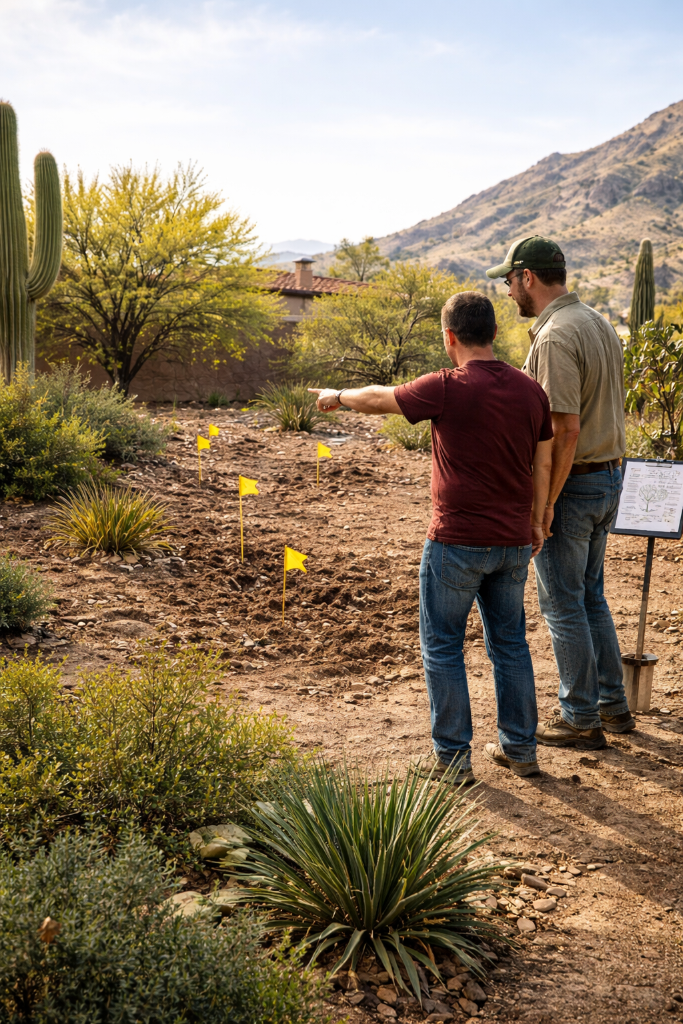
Our approach starts with your property, not a catalogue. We walk the planting site with you — assessing soil depth, sun exposure, drainage patterns, existing irrigation access, and the mature size of neighbouring trees and structures. From there we recommend species that will genuinely thrive in that specific spot, not just survive.
For Tucson properties, our top native recommendations include the Blue Palo Verde (Parkinsonia florida) for its spectacular spring bloom and low water needs, the Velvet Mesquite (Prosopis velutina) for fast growth and deep shade, the Desert Willow (Chilopsis linearis) for its hummingbird-attracting flowers through summer, and the native Ironwood (Olneya tesota) for its extreme drought tolerance and beautiful purple blooms. Each one is adapted to survive — and flourish — in the Sonoran Desert.
Blue Palo Verde
Parkinsonia florida
Spectacular spring bloom · Low water · Fast growing
Velvet Mesquite
Prosopis velutina
Deep shade · Fast growth · Desert native
Desert Willow
Chilopsis linearis
Summer flowers · Hummingbird magnet · Drought tolerant
Native Ironwood
Olneya tesota
Extreme drought tolerance · Purple blooms · Long-lived
Everything from selection to establishment
Tree Selection Consultation
Before we recommend a single species, we want to understand your goals — shade, privacy, seasonal bloom, wildlife habitat, low water use, or some combination. We walk your property and assess the specific planting site: soil depth and composition, afternoon vs. morning sun, proximity to structures and utilities, existing irrigation, and what the tree will look like at 10, 20, and 30 years of maturity.
Selection consultation is included with every planting job — because planting the wrong tree isn’t a service, it’s a mistake. We present both native and non-native options with honest trade-offs, and let you make an informed choice.
Professional Tree Planting
Proper planting is more than digging a hole. The planting hole should be two to three times as wide as the root ball but no deeper — a mistake here causes the tree to settle below grade, drowning the root flare and inviting rot. We position the tree with the root flare at or slightly above the soil surface, backfill with native soil rather than amendments that create a ‘flower pot effect’, and form a temporary watering basin around the drip edge to direct the first season’s irrigation exactly where the roots need it.
First-year establishment in Tucson’s climate is critical. The decisions made at planting — depth, drainage, staking, initial watering — determine whether your tree thrives or struggles through its first Tucson summer.
Soil Preparation & Aftercare
In Tucson, soil preparation is not optional — it’s the difference between a tree that thrives and one that stalls. We break through compacted caliche, incorporate organic matter to improve drainage and microbial activity, and set up the initial watering schedule based on the species and time of year.
We also walk you through a first-year aftercare plan — because a new tree’s establishment period determines everything that comes after. Get it right in year one and the tree earns its independence by year three. We provide species-specific watering guidance and follow up after the first season to ensure the tree is establishing well.
Free Mulch Drop Program
Our free mulch drop program offers locally sourced desert woodchips — primarily Mesquite and Pine — to Tucson homeowners who want to protect their trees and garden beds the natural way. A 3–4 inch layer of woodchip mulch around the drip zone of an established tree can reduce watering frequency by up to 30%, regulate soil temperature through our brutal summers, and improve soil biology as it breaks down over time.
Mulch drops are available by request, by availability, and require acceptance of a full truckload (approximately 4 tons). We do not chip Oleander or Palm. Call ahead to check availability — when we have a load ready, we can usually deliver within the week.