Tree Trimming & Care
Certified Tree Trimming & Pruning for Tucson’s Desert Trees
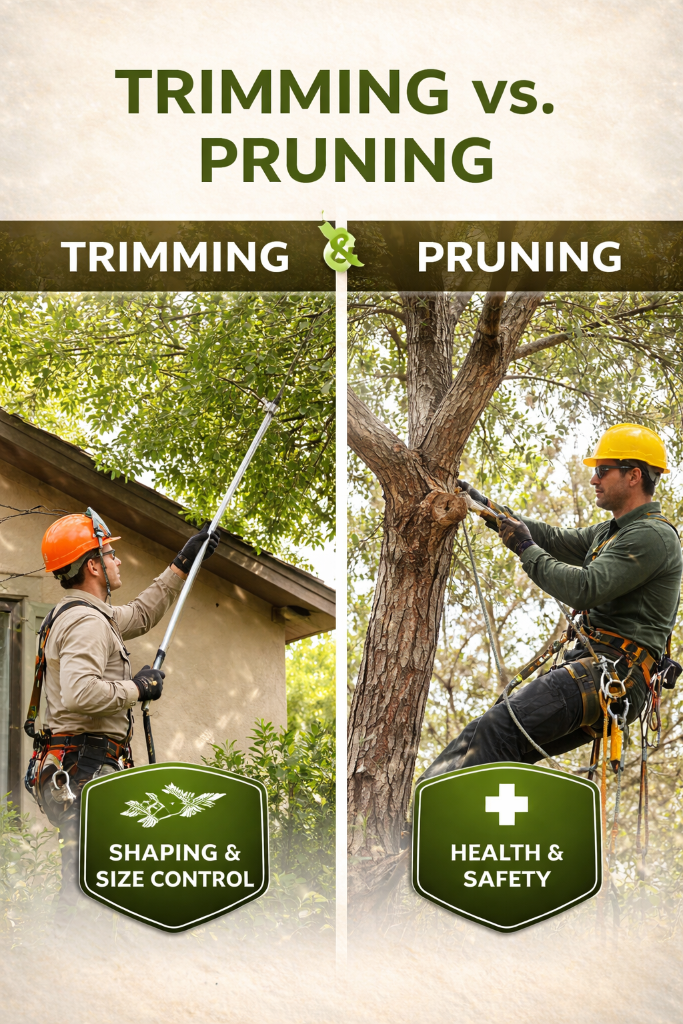
Why trimming and pruning aren’t the same thing
In Tucson, timing is everything. Native species like Mesquite and Palo Verde should generally be trimmed after the monsoon season — not before — when the tree has had time to harden its growth and is less vulnerable to sunscald from exposed heartwood. Trimming in the peak of summer can stress already heat-burdened trees and open wounds that insects exploit. We schedule every job around the science, not just the calendar.
Every cut we make follows ISA (International Society of Arboriculture) pruning standards — the same guidelines used by certified arborists worldwide. That means no flush cuts, no topping, and no ‘lion’s tailing’ that strips interior branches and destabilises the canopy. When we’re done, your tree is healthier than when we arrived — not just smaller.
Complete tree care — not just trimming
Tree Trimming & Crown Shaping
Crown shaping is one of the most visible services we offer — and one of the most commonly done wrong. Our approach lifts the lower canopy to improve light and air circulation at ground level, reduces overall crown size using natural reduction cuts that follow the tree’s own branching pattern, and removes deadwood that creates risk in Tucson’s high-wind monsoon season. The result is a tree that looks intentional — shaped by someone who understands how it grows.
We handle crown work on all native Tucson species, including Mesquite, Palo Verde, Desert Willow, Blue Palo Verde, and Ironwood, as well as non-native ornamentals and shade trees. Where structures are nearby — rooflines, driveways, block walls, or power line corridors — we factor in clearance requirements from the start, not as an afterthought.
Insect & Disease Management
Tucson’s heat and drought stress make trees vulnerable to a range of insects and diseases — and early detection is everything. Bark beetles target already-stressed trees, boring through the bark and disrupting water flow. Mistletoe is a parasitic plant that slowly weakens even healthy native trees if left unmanaged. Fungal diseases like phytophthora thrive in overwatered or poorly drained root zones. We identify these issues during every assessment and provide targeted treatment before they become irreversible.
Our approach is proactive, not just reactive. Every time we’re on your property, we’re looking for signs of pest activity, disease progression, or environmental stress. Caught early, most of these problems are manageable. Left until they’re obvious, many are not.ies, including Mesquite, Palo Verde, Desert Willow, Blue Palo Verde, and Ironwood, as well as non-native ornamentals and shade trees. Where structures are nearby — rooflines, driveways, block walls, or power line corridors — we factor in clearance requirements from the start, not as an afterthought.
Cabling & Bracing
Some trees are worth saving — even when their structure has become a liability. Cabling and bracing provides supplemental support for trees with co-dominant stems, significant lean, or weak branch unions that could fail under monsoon wind loads. When installed correctly by a certified arborist, cabling is invisible from the ground, harmless to the tree, and can extend the life of a mature specimen by decades.
The best candidates for structural support are large, mature trees with significant property value or sentimental importance — a 40-year-old Mesquite in a front yard, or a Palo Verde that anchors the character of a garden. We assess whether cabling is the right answer or whether selective pruning to redistribute canopy weight is more appropriate.
Soil Care & Fertilization
Tucson’s native soil often contains a dense layer of caliche — compacted calcium carbonate that blocks root penetration and traps water in the wrong places. Our soil care program breaks through this barrier using deep root fertilisation, targeted soil amendments, and organic matter that improves drainage and nutrient availability. A tree growing in healthy soil is a tree that fights off insects, tolerates drought, and grows with purpose.
Tree health starts underground. When a tree is struggling — dropping leaves, growing slowly, showing tip dieback — the cause is often in the soil rather than the canopy. We assess the root environment as part of every comprehensive assessment, and our soil treatments are tailored to the species and the site, not applied as a one-size-fits-all solution.